
Introduction
If you’re trying to give your skin a boost — smoother texture, fewer fine lines, better hydration — you might have come across collagen gummies as a convenient option. But not all collagen gummies are created equal. A big distinction lies in their sugar content: regular collagen gummies often contain added sugars (to taste better), while sugar-free collagen gummies skip or minimize sugar, using alternative sweeteners instead.
When your goal is skin health, the sugar content actually matters. While collagen peptides can support the skin’s structure, added sugar in your supplement can work against those benefits. In this post we’ll explore how sugar affects skin and collagen, compare sugar-free vs regular collagen gummies, and help you decide which is the better fit for your skin health goals.
Why Sugar Matters When You’re Taking Collagen
Glycation & Skin Aging
When excess sugar circulates in your body, it can bind to proteins — including collagen and elastin — in a process called glycation. This leads to Advanced Glycation End-Products (AGEs), which can damage skin structure and accelerate signs of aging.
In other words, taking collagen is one thing — but if you’re adding sugar at the same time, you may be partially working against yourself.
Inflammation & Skin Health
High sugar intake can increase inflammation in the body, which affects skin by making it more prone to breakouts, redness, less elasticity, and slower repair. Sugar-free options help you avoid that extra inflammatory load.
Blood Sugar & Skin
Spikes in blood sugar affect hormonal balance and skin health (e.g., acne, impaired wound repair). Using a low-sugar or sugar-free supplement reduces that risk.
Regular Collagen Gummies: Pros & Cons
Pros
- They often taste better, making consistent daily use easier.
- Easier to chew, convenient, on-the-go.
- Familiar candy-like format which many people prefer.
Cons
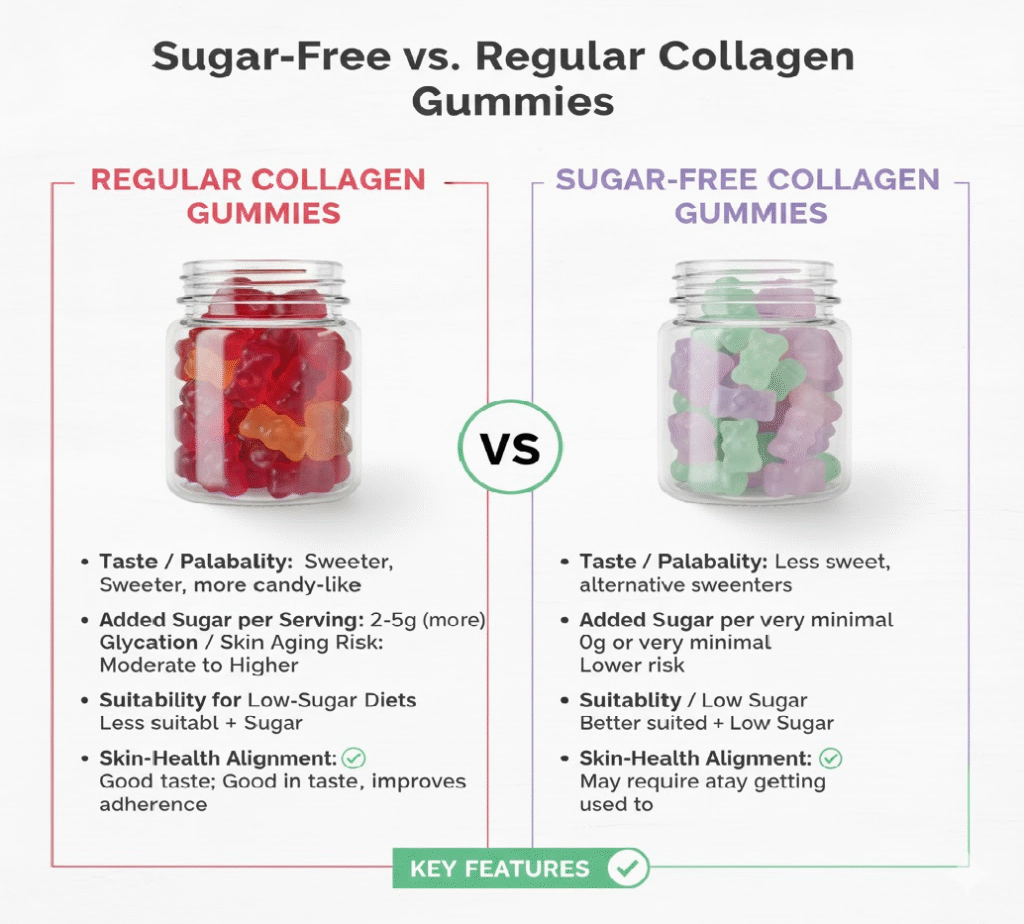
- May contain added sugars (2-5 grams or more per serving) and caloric load.
- The sugar can undermine collagen benefits via glycation and inflammation.
- Larger sugar load may not align with skin-health, anti-aging or low-sugar diet goals.
Sugar-Free Collagen Gummies: Pros & Cons
Pros
- Better aligned with low-sugar, anti-aging, skin-health oriented diets.
- Reduced risk of glycation damage from your supplement itself.
Cons
- May taste slightly less “candylike” because of alternative sweeteners.
- Possibly more expensive (premium branding for sugar-free versions).
- As with all supplements: quality of collagen, dose, ingredient synergy still matters — sugar-free doesn’t guarantee effectiveness on its own.
Which Is Better for Skin Health? - Given the skin health goal, sugar-free collagen gummies generally come out ahead — for the following reasons:
- They avoid the sugar that can undermine collagen benefits via glycation and inflammation.
- They support a clean nutrition approach which is important for anti-aging skin: minimizing sugar, maximizing structural protein (collagen) + supportive nutrients (vitamin C, biotin, hyaluronic acid).
- They allow you to supplement with collagen without adding unwanted sugar load that may offset skin gains.
- However — “better” does not simply mean sugar-free. The actual effectiveness depends on multiple factors:
- Quality of collagen peptides (source, type, degree of hydrolysis, dose).
- Consistent use: Supplementation effects accumulate over weeks/months.
- Lifestyle factors: Nutrition, sleep, UV protection, hydration, low stress — all impact skin health and collagen effectiveness.
Which Is Better for Skin Health?
Given the skin health goal, sugar-free collagen gummies generally come out ahead — for the following reasons:
- They avoid the sugar that can undermine collagen benefits via glycation and inflammation.
- They support a clean nutrition approach which is important for anti-aging skin: minimizing sugar, maximizing structural protein (collagen) + supportive nutrients (vitamin C, biotin, hyaluronic acid).
- They allow you to supplement with collagen without adding unwanted sugar load that may offset skin gains.
However — “better” does not simply mean sugar-free. The actual effectiveness depends on multiple factors:
- Quality of collagen peptides (source, type, degree of hydrolysis, dose).
- Supporting nutrients: vitamin C is critical for collagen synthesis; hyaluronic acid supports hydration; biotin supports skin/nail/hair.
- Consistent use: Supplementation effects accumulate over weeks/months.
- Lifestyle factors: Nutrition, sleep, UV protection, hydration, low stress — all impact skin health and collagen effectiveness.